
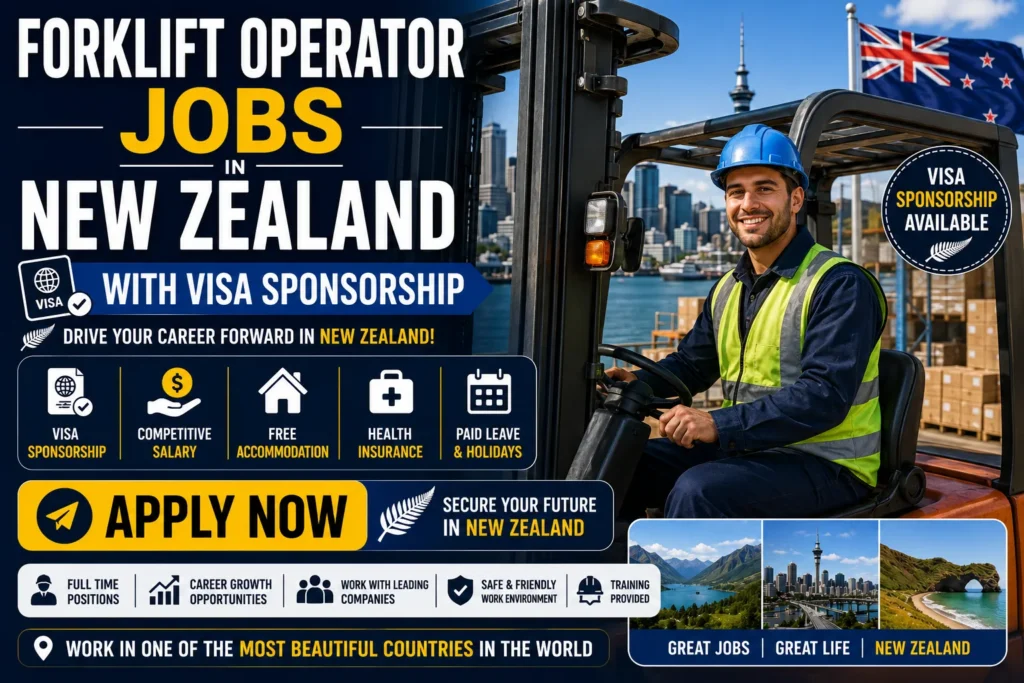
If you are an experienced forklift operator looking for an overseas job, Forklift Operator Jobs in New Zealand with Visa Sponsorship 2026 can be an option worth exploring. New Zealand employers in warehousing, logistics, manufacturing, distribution, construction and freight may recruit experienced workers when they cannot fill suitable positions locally.
For overseas applicants, the most important work-visa route to understand is the Accredited Employer Work Visa (AEWV). This visa requires a full-time job offer from an accredited New Zealand employer with an approved job check. The role must generally provide at least 30 hours of work per week.
However, applicants should understand that not every forklift operator vacancy offers visa sponsorship. Sponsorship depends on the employer, the specific position, the job check and the applicant meeting Immigration New Zealand requirements.
Forklift Operator Jobs in New Zealand 2026 at a Glance
| Job Details | Information |
|---|---|
| Job Title | Forklift Operator / Forklift Driver |
| Country | New Zealand |
| Job Type | Full-time |
| Industries | Warehousing, logistics, manufacturing, freight, distribution |
| Main Visa Route | Accredited Employer Work Visa (AEWV) |
| Experience | Usually previous forklift experience preferred |
| Licence/Certification | Relevant New Zealand forklift certification or employer-required evidence |
| Work Hours | AEWV jobs must generally offer at least 30 hours per week |
| English | May be required depending on the job’s skill level |
| Sponsorship | Available only where the employer and position meet immigration requirements |
Also Check: Aged Care Worker Jobs in New Zealand with Visa Sponsorship 2026
What Does a Forklift Operator Do?
A forklift operator is responsible for moving, loading, unloading and organizing goods using powered industrial equipment.
Typical responsibilities can include:
- Operating forklifts safely
- Loading and unloading trucks
- Moving pallets around warehouses
- Stacking products and materials
- Checking incoming and outgoing goods
- Preparing orders for dispatch
- Operating warehouse equipment
- Following workplace health and safety procedures
- Inspecting forklifts before use
- Reporting damaged equipment or products
- Maintaining accurate inventory movements
- Keeping work areas clean and organized
Depending on the employer, you may operate counterbalance forklifts, reach trucks or other material-handling equipment.
Where Can Forklift Operators Work in New Zealand?
Forklift operators can find employment in several industries.
Warehouses
Large warehouses and distribution centres use forklifts to move pallets, stock and other materials.
Logistics and Freight
Freight companies need operators to load and unload shipments and move goods between storage and transport areas.
Manufacturing
Manufacturing companies may use forklifts to transport raw materials, finished products and heavy equipment.
Food and Beverage
Food distribution facilities can require forklift operators to move packaged goods and pallets through warehouses and cold-storage facilities.
Construction and Building Materials
Construction suppliers may use forklift operators to move timber, building materials, machinery and other heavy products.
Ports and Distribution Facilities
Some logistics operations around ports and freight hubs require experienced material-handling workers.
Can Foreigners Get Forklift Operator Jobs in New Zealand?
Yes, foreigners can work in New Zealand if they obtain the appropriate visa and satisfy the requirements for the particular job.
For an AEWV, Immigration New Zealand requires a full-time job offer from an AEWV-accredited employer. The employer must also have an approved job check for the position.
This means an overseas applicant should not simply search for a company willing to “sponsor” them. Instead, look for an employer that:
- Is accredited to hire migrant workers.
- Has, or can obtain, an approved job check for the position.
- Offers a genuine full-time position.
- Meets New Zealand employment and immigration requirements.
- Is prepared to support the worker’s AEWV application.
Immigration New Zealand maintains an official accredited employer database that can be used to check whether an employer is currently accredited. The database is updated daily.
Visa Sponsorship for Forklift Operators
In New Zealand, the term visa sponsorship is commonly used by international job seekers, but the formal process for many employer-sponsored workers is the Accredited Employer Work Visa.
Under the AEWV system, an accredited employer can support an overseas worker after the employer has completed the required accreditation and job-check processes.
The employer must provide the worker with the information needed for the visa application, including the job offer, job description, employment agreement and the unique application link.
Important
A job advertisement saying “visa sponsorship available” does not automatically mean that every overseas applicant will qualify for a visa.
The employer, position and applicant must all meet the relevant requirements.
Accredited Employer Work Visa Requirements
To apply for an AEWV, you generally need:
- A full-time job offer
- An offer from an accredited employer
- An approved job check for the position
- Relevant skills, experience and/or qualifications
- Evidence that you meet the requirements of the occupation
- English evidence where required by the job’s skill level
- Good health
- Good character
- A genuine intention to work in New Zealand
Immigration New Zealand currently states that an AEWV can allow eligible workers to stay for up to 5 years, depending on the job, skill level, pay and other circumstances.
Forklift Driver Skill Level
Forklift Driver is identified under ANZSCO code 721311. Immigration New Zealand’s 2026 amendment circular lists Forklift Driver among occupations that may be treated as ANZSCO skill level 3 when the role’s skill requirements are equivalent to those of a skill level 3 position.
This can be important because AEWV requirements, including English-language requirements, can depend on the skill level assigned to the specific job.
The actual requirements should therefore be checked against the occupation and job description used by the employer rather than assuming every forklift job has exactly the same immigration conditions.
Do Forklift Operators Need English?
English requirements depend on the skill level and circumstances of the particular AEWV application.
Immigration New Zealand states that applicants whose job is ANZSCO or NOL skill level 3 to 5 generally need to demonstrate that they can speak and understand English, subject to specified exemptions. Skill level 1 and 2 jobs do not require English evidence under this particular AEWV rule.
For forklift operators, applicants should therefore check the skill level assigned to the specific position before assuming that IELTS or another English test will or will not be required.
Forklift Licence and Certification
Forklift requirements can vary between employers and workplaces.
A New Zealand employer may require evidence of:
- Previous forklift operating experience
- Forklift training
- A relevant operator certificate
- Workplace safety training
- Experience operating a particular forklift type
- Experience in warehouses or distribution centres
If you are applying from overseas, include details of your forklift training and certifications on your CV.
You should clearly state:
- Type of forklift operated
- Years of experience
- Maximum load handled
- Warehouse experience
- Loading/unloading experience
- Reach-truck experience, if applicable
- Counterbalance experience, if applicable
- Safety training
- Previous employers
Forklift Operator Salary in New Zealand
Forklift operator salaries vary according to experience, location, shift patterns, employer and the type of work.
Some positions may pay hourly wages, while others may offer additional payments for night shifts, overtime, weekends or specialized duties.
When comparing vacancies, look beyond the headline hourly rate and check:
- Basic hourly pay
- Overtime rate
- Weekend allowances
- Night-shift allowance
- Guaranteed weekly hours
- Holiday pay
- Accommodation, if offered
- Relocation assistance
- Transport arrangements
- Training costs
Do not accept a salary figure from an unofficial recruitment website as a guaranteed rate. The employment agreement should state the actual pay and conditions.
Benefits of Working as a Forklift Operator in New Zealand
Depending on the employer, forklift operators may receive benefits such as:
- Full-time employment
- Overtime opportunities
- Paid annual leave
- Public holiday entitlements
- Workplace training
- Safety equipment
- Career development
- Shift allowances
- Potential relocation assistance
- Potential visa support
Benefits differ significantly between employers, so read the complete job description before applying.
Cities and Regions with Forklift Jobs
Forklift and warehouse jobs can be found in many parts of New Zealand.
Potential locations include:
Auckland
Auckland is New Zealand’s largest urban area and has a large logistics, warehousing and distribution sector.
Christchurch
Christchurch has opportunities connected with logistics, manufacturing, distribution and freight.
Hamilton
Hamilton and the wider Waikato region have significant agricultural, manufacturing and distribution activity.
Tauranga
Tauranga is an important logistics and freight location, creating demand for workers across the supply chain.
Wellington
The Wellington region also has warehouse, freight and distribution operations.
Dunedin
Dunedin has opportunities in warehousing, manufacturing, retail distribution and logistics.
Job availability changes frequently, so applicants should search across multiple regions instead of limiting themselves to one city.
How to Find Forklift Operator Jobs with Visa Sponsorship
The best strategy is to combine general job boards with direct employer research.
1. Search New Zealand Job Websites
Use keywords such as:
- Forklift Operator Jobs New Zealand
- Forklift Driver Jobs New Zealand
- Forklift Jobs with Visa Sponsorship New Zealand
- Forklift Driver Visa Sponsorship
- Warehouse Jobs New Zealand
- Warehouse Operator Jobs New Zealand
- Reach Truck Operator New Zealand
- Counterbalance Forklift Jobs New Zealand
- Logistics Jobs with Visa Sponsorship
- Forklift Operator AEWV
2. Check the Employer
Before applying, investigate the employer.
If the employer claims to support an AEWV application, check whether the company appears on Immigration New Zealand’s accredited employer list.
3. Read the Job Advertisement Carefully
Look for terms such as:
- Accredited employer
- AEWV
- Visa support
- Overseas applicants considered
- Relocation assistance
- International applicants
- Full-time position
Remember that these terms are not guarantees of visa approval.
4. Prepare Your CV
Your CV should highlight your forklift experience instead of simply saying “warehouse worker.”
For example:
Forklift Operator | 5 Years’ Experience
- 5 years of counterbalance forklift experience
- Loading and unloading heavy goods
- Warehouse inventory handling
- Pallet stacking
- Truck loading
- Workplace safety compliance
- Forklift inspection and maintenance reporting
5. Apply Directly
Submit your CV through the employer’s official careers page or a reputable job board.
Avoid sending money to individuals who claim they can guarantee a job or visa.
Documents You May Need
Prepare digital copies of:
- Passport
- Updated CV
- Forklift licence or training certificate
- Previous employment certificates
- Reference letters
- Training certificates
- Educational certificates, if relevant
- English-language evidence, if required
- Police certificates, if requested
- Medical documentation, if requested
- Other immigration documents
Documents that are not in English may need certified translations depending on the application requirements.
How to Write a Forklift Operator CV
A strong CV should contain:
Personal Details
Include:
- Full name
- Phone number
- Email address
- Current country
- City and country
Professional Summary
Write a short summary describing your experience and forklift skills.
Work Experience
For each employer, include:
- Company name
- Position
- Location
- Employment dates
- Main responsibilities
Forklift Skills
List specific equipment and duties, such as:
- Counterbalance forklift
- Reach truck
- Pallet handling
- Truck loading
- Container unloading
- Warehouse operations
- Stock movement
- Safety procedures
Certifications
List relevant forklift training and certificates with their issuing organization and dates.
Step-by-Step Application Process
Step 1: Check Your Experience
Make sure you meet the employer’s experience requirements.
Step 2: Prepare Your CV
Create a professional CV specifically for forklift and warehouse positions.
Step 3: Search for Suitable Vacancies
Search reputable New Zealand job websites and employer career pages.
Step 4: Verify the Employer
Check the employer’s business details and AEWV accreditation where relevant.
Step 5: Submit Your Application
Apply through the official application channel.
Step 6: Attend the Interview
Be prepared to discuss:
- Forklift experience
- Types of forklifts operated
- Safety procedures
- Warehouse experience
- Availability
- Shift work
- Relocation
- Visa requirements
Step 7: Receive a Genuine Job Offer
If selected, the employer should provide formal employment information.
Step 8: Apply for the Appropriate Visa
For an AEWV, the employer must have the required accreditation and job check before supporting the worker’s application.