
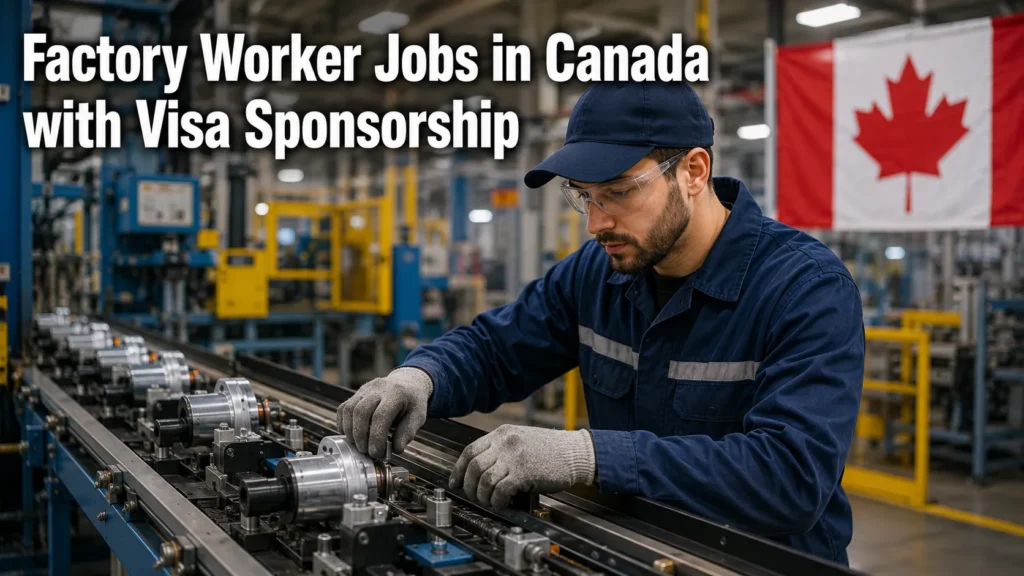
Canada has a large manufacturing and processing sector that employs workers in food production, automotive manufacturing, machinery, plastics, metal fabrication, packaging, furniture, building materials, and other industries. Factories need reliable employees to operate equipment, prepare products, package goods, inspect finished items, and maintain safe production environments.
Factory Worker Jobs in Canada with Visa Sponsorship 2026 may interest overseas workers who have manufacturing, production, warehouse, machine-operation, or industrial experience. Opportunities can include factory labourers, production workers, machine operators, packaging workers, food processing workers, assembly workers, material handlers, and manufacturing technicians.
Visa sponsorship is not guaranteed for every factory position. For many temporary foreign workers, the employer may need a Labour Market Impact Assessment (LMIA) before the worker can apply for an employer-specific work permit. Canada’s official Job Bank also provides a dedicated search for employers recruiting temporary foreign workers, including employers that have already obtained or applied for an LMIA.
Job Overview
Factory workers support production operations and help companies manufacture, package, inspect, and move products. Duties depend on the industry, machinery, workplace, and level of experience.
Job Title: Factory Worker / Production Worker / Manufacturing Labourer / Machine Operator / Packaging Worker / Assembly Worker
Country: Canada
Job Type: Full-Time / Permanent / Seasonal / Contract, depending on the employer
Experience Required: Previous factory, manufacturing, production, or machine-operation experience may be preferred
Education Required: Usually depends on the employer and position
Visa Sponsorship: May be available for eligible overseas workers where the employer and position meet current immigration requirements
Work Locations: Ontario, Quebec, British Columbia, Alberta, Manitoba, Saskatchewan, and other Canadian provinces and territories
Salary: Varies according to employer, location, occupation, experience, and working hours
Some employers may provide overtime, training, uniforms, employee benefits, or accommodation for selected positions.
Why Factory Workers Are Needed in Canada
Manufacturing is an important part of Canada’s economy. Factories produce food products, machinery, vehicles, building materials, consumer goods, plastics, metal products, and many other items.
Production facilities depend on workers who can maintain output while following quality and safety procedures. Some factories operate around the clock, creating different shift patterns and employment opportunities.
Current Job Bank listings demonstrate that foreign-worker recruitment can include manufacturing positions. Recent listings have included factory labourers, food processing labourers, CNC machining tool operators, plastic extruder operators, and metal-fabrication machine operators.
Types of Factory Jobs Available
Factory Labourer
Factory labourers perform general production duties such as moving materials, cleaning work areas, loading products, and assisting production teams.
Production Worker
Production workers support manufacturing processes and may operate equipment, assemble products, inspect items, and prepare goods for the next stage.
Machine Operator
Machine operators use industrial machinery to manufacture, shape, cut, process, or package products. Technical training may be required for some positions.
Packaging Worker
Packaging workers prepare finished products for storage and shipment. They may label boxes, check quantities, operate packaging equipment, and maintain clean workstations.
Food Processing Worker
Food processing workers prepare, process, package, and inspect food products while following hygiene and workplace safety requirements.
Assembly Worker
Assembly workers put together components to create finished products. They may use hand tools, machinery, measuring equipment, or automated production systems.
Manufacturing Technician
Manufacturing technicians may perform more technical duties involving machinery, production systems, testing, maintenance, or quality control.
Also Check: Cleaner Jobs in New Zealand with Visa Sponsorship 2026
Job Responsibilities
Factory duties vary between industries, but common responsibilities may include:
- Operating production machinery
- Assembling products
- Sorting materials
- Loading and unloading products
- Packaging finished goods
- Labelling products
- Inspecting products for defects
- Measuring materials
- Preparing production areas
- Moving raw materials
- Cleaning machinery and work areas
- Recording production information
- Following production schedules
- Reporting equipment problems
- Following workplace safety procedures
- Wearing required protective equipment
- Meeting production and quality standards
Experienced workers may also train new employees, operate specialised machinery, monitor production lines, or assist supervisors.
Salary and Employee Benefits
Factory salaries in Canada vary according to the province, industry, occupation, employer, experience, and shift schedule. Machine operators and skilled manufacturing workers may earn different wages from entry-level production labourers.
Recent Job Bank listings show the range can vary considerably. For example, a current plastic extruder operator listing in Quebec advertised $23 to $33 per hour, while a factory labourer-manufacturing position advertised $23 to $28 per hour. Actual wages depend on the specific employer and position.
Potential benefits may include:
- Regular wages
- Overtime pay where applicable
- Paid vacation
- Statutory benefits
- Pension plans where offered
- Workplace training
- Employee discounts
- Uniforms or protective equipment
- Shift premiums
- Accommodation for selected positions
Applicants should confirm the exact wage, working hours, overtime arrangements, deductions, benefits, and accommodation directly with the employer.
Visa Sponsorship Process
International factory workers should understand that Canada does not provide a general “factory worker visa.” The immigration process depends on the job, employer, province, and applicable work permit program.
An employer-specific work permit generally requires a job offer. In many temporary foreign worker situations, the employer may need an LMIA before the worker applies for the work permit. Canada’s official guidance confirms that an employer-specific work permit requires a job offer.
The process may generally involve:
Step 1: Find a Factory Job
Search Canadian manufacturers, food processing companies, packaging businesses, industrial companies, and other legitimate employers.
Step 2: Check the Employer
Confirm that the company is genuine and determine whether it recruits foreign workers.
Step 3: Check LMIA Status
Ask whether the employer has an approved LMIA, has applied for one, or is willing to complete the required process where applicable.
Step 4: Prepare Your CV
Create a factory-focused CV showing your manufacturing experience, machine skills, production duties, safety training, and previous employers.
Step 5: Submit Your Application
Apply through the employer’s official website or Canada’s Job Bank. Job Bank specifically identifies positions that are open to international candidates, helping overseas applicants focus on suitable vacancies.
Step 6: Attend an Interview
Employers may conduct telephone or online interviews and ask about your production experience, shift availability, machinery knowledge, safety practices, and ability to work in a team.
Step 7: Receive a Job Offer
Review the employment contract carefully. Check the wage, working hours, duties, location, overtime, accommodation, and other conditions.
Step 8: Complete the LMIA Process
Where an LMIA is required, the employer handles the application. Employers must meet the applicable Temporary Foreign Worker Program requirements. The LMIA application itself has a processing fee paid by the employer; workers should not be asked to pay the employer’s LMIA fee.
Step 9: Apply for the Work Permit
After receiving the necessary documentation, the worker can apply for the appropriate Canadian work permit.
Step 10: Travel to Canada
Once the required immigration approval has been received, arrange travel and relocation according to the employment contract and work permit conditions.
Requirements for Factory Jobs
Requirements vary between employers, but applicants may generally need:
- Previous factory or manufacturing experience
- Ability to perform repetitive physical tasks
- Good attention to detail
- Basic communication skills
- Ability to follow instructions
- Teamwork skills
- Reliability
- Workplace safety awareness
- Ability to work different shifts
- Physical stamina
- Machine-operation experience where required
- Valid passport
- Genuine employment offer
- Appropriate work authorisation
Some entry-level factory jobs may provide workplace training, while machine-operation and technical positions can require previous experience or specific qualifications.
Skills That Can Improve Your Chances
Applicants can strengthen their CV by highlighting experience with:
- Production lines
- Machine operation
- Assembly
- Packaging
- Food processing
- Quality control
- Warehouse equipment
- Inventory handling
- Industrial machinery
- CNC machines
- Metal fabrication
- Workplace safety
- Equipment cleaning
- Production documentation
Experience working night shifts, rotating shifts, or high-volume production environments can also be useful.
Working Conditions
Factory work can be physically demanding. Workers may spend long periods standing, walking, lifting materials, operating machinery, or performing repetitive tasks.
Many manufacturing facilities operate multiple shifts. Employees may therefore work mornings, afternoons, nights, weekends, or holidays depending on the production schedule.
Safety is an important part of factory employment. Workers may need to use protective clothing, safety footwear, gloves, hearing protection, or other equipment depending on the workplace.
Employees should follow training instructions carefully when operating machinery or handling materials.
Advantages of Working in Canada’s Manufacturing Sector
Factory employment can provide international workers with practical experience in Canada’s industrial and manufacturing sectors.
Potential advantages include:
- International work experience
- Opportunities for entry-level workers
- Manufacturing experience
- Workplace training
- Overtime opportunities
- Exposure to modern production systems
- Career development
- Opportunities to learn machine operation
- Multicultural workplaces
With experience and additional training, workers may progress into machine operator, quality-control, team-leader, maintenance, or supervisory positions.
How to Apply
If you are interested in Factory Worker Jobs in Canada with Visa Sponsorship 2026, follow these steps:
- Prepare an updated factory worker CV.
- Highlight your manufacturing and production experience.
- Mention machinery or equipment you can operate.
- List relevant safety training and certificates.
- Include previous factory and production employers.
- Search Canada’s Job Bank and legitimate Canadian employers.
- Focus on vacancies open to international candidates.
- Check whether the employer has an LMIA or is recruiting through an applicable foreign-worker program.
- Apply through the employer’s official recruitment channel.
- Prepare for an interview.
- Review the job offer and employment contract.
- Confirm salary, hours, overtime, accommodation, and deductions.
- Complete the required work permit process if eligible.
- Arrange travel only after receiving the necessary immigration approval.
- Click Apply Now to get started
Applicants should be careful about recruitment scams. Canada’s Job Bank states that employers should never ask workers to pay them to obtain employment or pay the employer’s LMIA fee. Verify the company, vacancy, salary, LMIA status, contract, and immigration requirements before sending money or sensitive documents.
Final Thoughts
Factory Worker Jobs in Canada with Visa Sponsorship 2026 may provide opportunities for overseas workers with manufacturing, production, packaging, food processing, or machine-operation experience.
Canada’s Job Bank currently provides a dedicated service for temporary foreign workers and lists employers that have obtained or applied for an LMIA. It also identifies vacancies that are open to international candidates, making it a useful starting point for overseas job seekers.
Applicants should remember that sponsorship is not automatic. The employer, occupation, wage, LMIA requirements, and work permit conditions all matter. A job advertisement mentioning LMIA or foreign workers does not guarantee that an individual applicant will receive a work permit.
Before accepting an offer or making travel arrangements, verify the employer, salary, working conditions, LMIA status, accommodation, deductions, and current Canadian immigration requirements. Use official Canadian government resources and legitimate employers throughout the application process to reduce the risk of scams.
1 thought on “Factory Worker Jobs in Canada with Visa Sponsorship 2026”