
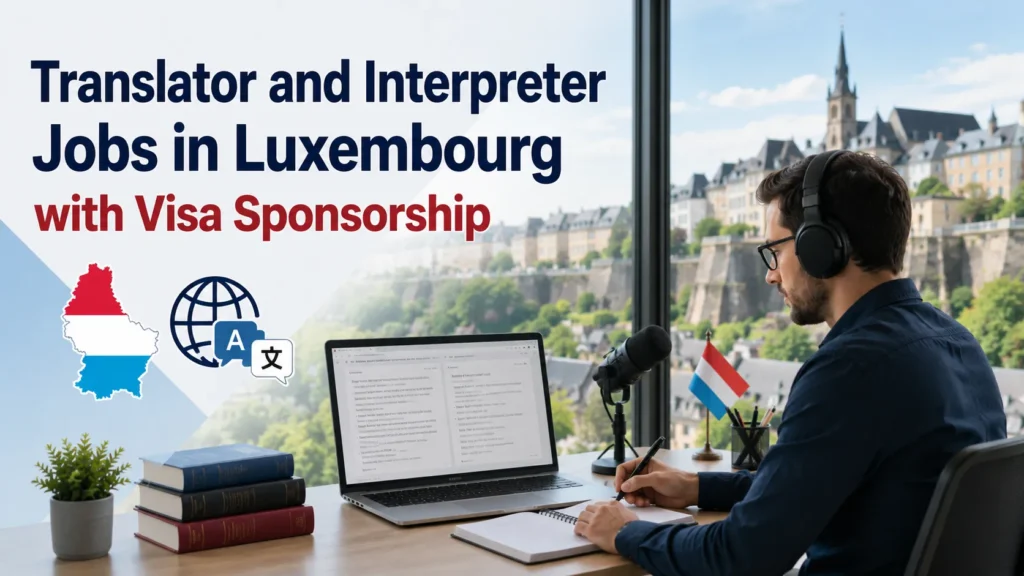
Luxembourg is a highly international country where people from different linguistic backgrounds live, work, and do business. Its financial sector, European institutions, technology companies, healthcare organisations, tourism businesses, legal firms, and government services often need professionals who can communicate across languages.
Translator and Interpreter Jobs in Luxembourg with Visa Sponsorship 2026 may interest qualified language professionals from outside the European Union who want to build an international career. Opportunities can include translators, interpreters, conference interpreters, legal translators, medical interpreters, technical translators, localization specialists, and language support professionals.
However, visa sponsorship is not guaranteed for every vacancy. Non-EU nationals generally need the appropriate authorisation to work and reside in Luxembourg. Depending on the position and qualifications, different immigration routes may apply.
Job Overview
Translators convert written content from one language into another, while interpreters help people communicate through spoken language. Some professionals perform both roles.
Job Title: Translator / Interpreter / Language Specialist / Localization Specialist
Country: Luxembourg
Job Type: Full-Time / Part-Time / Contract, depending on the employer
Experience Required: Previous translation or interpreting experience is generally beneficial
Education Required: A language degree, translation qualification, interpreting certification, or relevant professional experience may be required
Visa Sponsorship: May be available for eligible international workers, depending on the employer and immigration requirements
Work Locations: Luxembourg City and other locations across Luxembourg
Salary: Varies according to experience, language combination, qualifications, employer, and position
Some employers may also offer paid leave, professional training, flexible working arrangements, bonuses, and other employee benefits.
Why Translators and Interpreters Are Needed in Luxembourg
Luxembourg has a multilingual environment, with Luxembourgish, French, and German widely used alongside English and other international languages. International businesses and organisations may require language professionals to communicate with employees, customers, partners, government bodies, and visitors.
The country’s financial services industry is another potential source of opportunities. Banks, insurance companies, investment firms, and other financial businesses may require translated documents and multilingual communication.
Legal, healthcare, technology, education, tourism, and public-sector organisations can also require professional language services.
Types of Translator and Interpreter Jobs Available
Translator
Translators work with written material such as business documents, websites, reports, contracts, manuals, marketing content, and correspondence.
Interpreter
Interpreters help people communicate during meetings, appointments, interviews, conferences, and other spoken interactions. They may provide consecutive or simultaneous interpreting depending on the assignment.
Legal Translator
Legal translators work with contracts, legal documents, policies, court-related material, and other specialised content. Strong knowledge of legal terminology is important.
Medical Interpreter
Medical interpreters support communication between healthcare professionals and patients who speak different languages. Accuracy, confidentiality, and professional conduct are essential.
Technical Translator
Technical translators work with specialised content such as software documentation, engineering material, product manuals, and technical instructions.
Conference Interpreter
Conference interpreters provide real-time language support during conferences, business events, international meetings, and institutional events.
Localization Specialist
Localization specialists adapt websites, applications, software, and digital content for specific languages and markets. Their work involves more than direct translation and may include cultural adaptation.
Also Check: Cleaner Jobs in Luxembourg with Visa Sponsorship 2026
Job Responsibilities
Responsibilities depend on the employer and specialisation. Common duties may include:
- Translating written documents
- Interpreting spoken conversations
- Reviewing translated material
- Checking grammar and terminology
- Maintaining translation accuracy
- Researching technical terms
- Preparing multilingual documents
- Supporting international meetings
- Translating websites and digital content
- Localising software and applications
- Maintaining confidentiality
- Working with translation tools
- Meeting project deadlines
- Communicating with clients
- Proofreading and editing translations
Interpreters may also need to prepare for meetings by studying terminology and understanding the subject being discussed.
Salary and Employee Benefits
Translator and interpreter salaries in Luxembourg can vary considerably. Experience, language combination, qualifications, specialisation, employer, and employment type can all affect compensation.
Potential benefits may include:
- Competitive salary
- Paid annual leave
- Performance bonuses
- Professional training
- Flexible working arrangements
- Hybrid work opportunities where available
- Pension-related benefits
- Health-related benefits
- Career development opportunities
- Relocation assistance in selected positions
Applicants should always confirm the exact salary, working hours, benefits, and employment conditions before accepting an offer.
Visa Sponsorship Process
Non-EU citizens generally require appropriate permission to work in Luxembourg. For salaried employment lasting more than three months, third-country nationals generally need to complete the relevant temporary authorisation to stay and residence procedures.
For highly qualified professionals, the EU Blue Card can potentially provide another route when the applicant and job meet the applicable requirements.
The process may generally involve:
Step 1: Find a Job
Search official company career pages, reputable recruitment websites, employment platforms, and language-service companies.
Step 2: Check Sponsorship
Confirm whether the employer is willing to consider candidates who require immigration or relocation support. Do not assume every vacancy offers sponsorship.
Step 3: Review the Requirements
Check the required languages, qualifications, interpreting experience, translation experience, software knowledge, and industry expertise.
Step 4: Prepare Your CV
Create a clear CV highlighting your language combinations, qualifications, professional experience, specialisations, and major projects.
Step 5: Submit Your Application
Apply through the employer’s official recruitment channel and provide requested documents and certificates.
Step 6: Attend Interviews
Employers may assess language ability, translation accuracy, communication skills, subject knowledge, and professional experience.
Step 7: Receive an Offer
If selected, the employer may provide an employment contract and begin the applicable hiring and immigration process.
Step 8: Complete Immigration Requirements
Complete the required authorisation and residence procedures before beginning employment.
Step 9: Relocate to Luxembourg
After receiving the necessary approval, arrange your relocation and begin work according to the employment agreement.
Requirements for Translator and Interpreter Jobs
Requirements differ between employers, but applicants may need:
- Degree in languages, translation, or a related field
- Professional translation or interpreting experience
- Strong command of relevant languages
- Excellent written and spoken communication
- Knowledge of specialised terminology
- Proofreading skills
- Computer literacy
- Translation software experience
- Attention to detail
- Time-management skills
- Confidentiality
- Valid passport
- Genuine employment offer
- Appropriate work authorisation
Professional certification can be helpful for specialised roles. Experience in areas such as law, finance, healthcare, technology, or business may also improve an applicant’s prospects.
Skills That Can Improve Your Chances
Applicants can strengthen their profiles by developing skills in:
- French
- German
- Luxembourgish
- English
- Multilingual communication
- Legal terminology
- Financial terminology
- Medical terminology
- Technical translation
- Localization
- Computer-assisted translation tools
- Proofreading
- Editing
- Research
- Cultural awareness
- Confidentiality
- Public speaking
The strongest language combination depends on the vacancy. Candidates should focus on the languages and specialist knowledge specifically requested by employers.
Working Conditions
Translators may work from offices, remotely, or in hybrid environments depending on the employer and project. Some translation roles are project-based, while others provide regular full-time employment.
Interpreters may have more varied working environments. They can work at conferences, meetings, offices, hospitals, business events, or other professional settings.
Some interpreting assignments may require travel or flexible working hours. Conference and simultaneous interpreting can also be demanding because professionals must listen, understand, and communicate information quickly and accurately.
Advantages of Working in Luxembourg
A language professional working in Luxembourg may gain valuable international experience and exposure to multilingual workplaces.
Potential advantages include:
- International career experience
- Multilingual professional environment
- Exposure to European businesses
- Opportunities in finance and international services
- Professional development
- Experience with international clients
- Potential career progression
- Opportunities to specialise in high-demand fields
Experienced professionals may progress into senior translator, language project manager, localization manager, language consultant, or specialised interpreting positions.
How to Apply
If you are interested in Translator and Interpreter Jobs in Luxembourg with Visa Sponsorship 2026, follow these steps:
- Prepare an updated language-focused CV.
- Clearly list your language combinations.
- Highlight translation or interpreting experience.
- Mention relevant qualifications and certifications.
- Include specialised industry experience.
- Prepare examples of previous work where appropriate.
- Search reputable Luxembourg employers and recruitment platforms.
- Check whether international applicants are accepted.
- Confirm sponsorship or relocation arrangements.
- Apply through the official recruitment channel.
- Prepare for language assessments and interviews.
- Review the employment contract carefully.
- Complete the required immigration procedures.
- Click Apply Now to get started
Applicants should also be careful about recruitment scams. A legitimate employer should provide clear information about the position, contract, salary, and recruitment process. Avoid anyone promising a guaranteed job or visa in exchange for large upfront payments.
Final Thoughts
Translator and Interpreter Jobs in Luxembourg with Visa Sponsorship 2026 can provide opportunities for skilled language professionals who have strong communication abilities, relevant qualifications, specialist knowledge, and professional experience.
Luxembourg’s multilingual environment and international economy create potential opportunities across finance, healthcare, legal services, technology, tourism, government, and other industries. Candidates who combine language expertise with knowledge of a specialised sector may have an advantage when applying for professional positions.
Visa sponsorship depends on the employer, job, applicant’s qualifications, and applicable immigration rules. Before accepting an offer or making travel arrangements, applicants should verify the employer, employment contract, salary, sponsorship arrangements, and current Luxembourg immigration requirements.
1 thought on “Translator and Interpreter Jobs in Luxembourg with Visa Sponsorship 2026”